
The most useful strawberry planting ideas start with the harvest you want, not the prettiest planter. June-bearing plants in a matted row give you one heavy crop for jam. Day-neutral plants in pots, hanging baskets, or towers give you smaller berries for months. Every layout still needs full sun, sharp drainage, slightly acidic soil, and a crown set exactly at soil level.
If you clicked through from a Pin of cascading baskets or a cedar pyramid, you can plant that. Match the system to your climate and your watering habits. A balcony basket that dries out twice a day will not behave like a mulched garden bed.
Choose a Planting Idea Based on the Harvest You Want
Start with the fruit, then pick the layout. June-bearing strawberries produce one concentrated crop in late spring or early summer and send out lots of runners. They belong in a bed you can let fill in. Oregon State University Extension notes that they fruit the year after planting.
Day-neutral cultivars flower when temperatures stay roughly between 40°F and 85°F to 90°F. They fruit in the planting year, make fewer runners, and suit pots, towers, and the hill system. Everbearing types sit in the middle, with two flushes rather than a steady trickle.
If you want freezer bags, plant June-bearers in a row and wait a year. If you want berries by midsummer, plant day-neutrals in containers and pinch the first flowers. Mixing both types in one small bed usually creates extra work because they need different runner rules.
June-bearing, everbearing, and day-neutral types
June-bearers are the workhorses for a traditional patch. Everbearers give a spring crop and a late-summer crop. Day-neutrals keep going until heat or frost shuts them down. Nursery tags sometimes label day-neutrals as “everbearing,” so read the variety name. Tribute, Tristar, Seascape, and Albion are common day-neutral choices.
Site, Soil, and Timing Rules That Decide Success
Strawberries need 6 to 8 hours of direct sun. Less sun means more leaves and fewer berries. They also need soil that drains fast. Shallow roots rot in soggy ground and bake in heavy clay. University of Maryland Extension recommends a raised bed at least 12 inches above grade when drainage is slow.
Aim for a soil pH between 5.5 and 6.5. Outside that range, iron and phosphorus can sit in the soil and still stay unavailable to the plant. Test before you plant, then add compost and any lime or sulfur your results call for.
Do not plant strawberries where tomatoes, peppers, potatoes, eggplant, or okra grew in the last three to five years. Those crops can leave behind Verticillium wilt, a soil fungus that wrecks strawberry roots. Utah State University Extension flags this rotation rule for a reason.
When to plant strawberries by climate
In cold-winter regions, plant dormant bare-root crowns in early spring as soon as the soil can be worked. Fall planting in the North invites frost heaving.
In much of the South and in Florida, young transplants go in from late September into October so roots establish in cool weather. UF/IFAS recommends that fall window for Florida gardens. Coastal California often plants in mid to late August.
In-Ground and Raised-Bed Strawberry Planting Ideas
A matted row is the classic backyard idea. Set June-bearing plants 15 to 24 inches apart in rows 3 to 4 feet apart. Let runners root until the row is about 18 to 24 inches wide, then clip extras. University of Minnesota Extension uses this system because June-bearers fill space quickly.
The hill system keeps each plant as an individual. Space plants 8 to 12 inches apart for day-neutrals, or a little wider for June-bearers, and remove runners all season. Fruit stays larger and easier to pick. You trade free daughter plants for extra clipping.
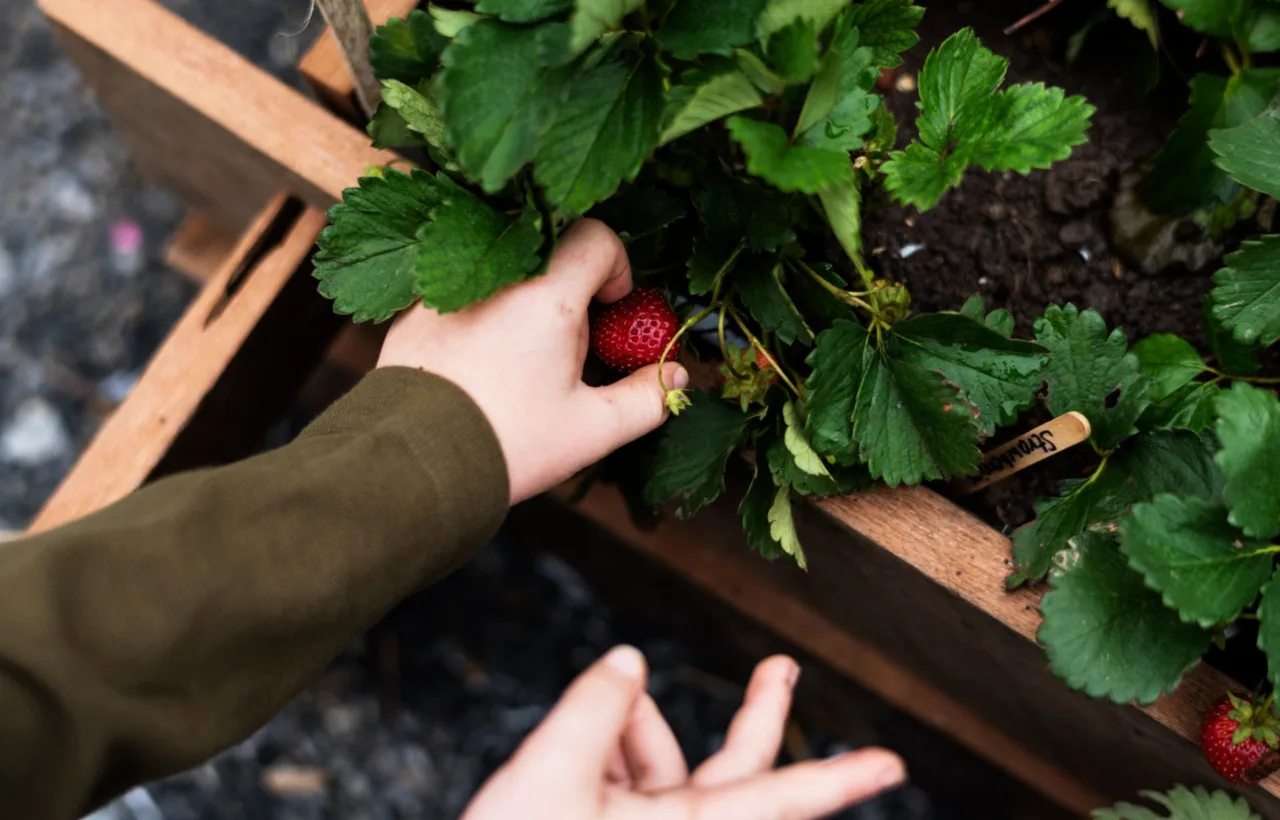
Raised beds solve heavy soil without a huge build. Keep the bed 3 to 4 feet wide so you can harvest from both sides. Eight to 12 inches of depth is enough if the mix drains.
A cedar pyramid is the Pinterest version of a raised bed: stacked squares that shrink as they rise, with plants around each rim. A three-tier pyramid on a 4-foot base can hold roughly 20 to 25 plants. Water the top tier carefully. Gravity feeds the bottom first.
| Planting idea | Space it needs | Plant type that fits | First-year fruit | Main tradeoff |
|---|---|---|---|---|
| Matted row in soil | 3–4 ft between rows | June-bearing | Little to none | Bigger later crop, more weeding |
| Hill system or raised bed | 8–12 in between plants | Day-neutral or June-bearing | Yes, after flower pinch | More runner clipping |
| Patio pots | 12 in wide, 8 in deep per plant | Day-neutral | Yes | Daily watering in heat |
| Hanging basket (12–14 in) | One sturdy hook | Day-neutral or trailing types | Yes | Dries out fast |
| Tower or pyramid | 2–16 sq ft of footprint | Day-neutral | Yes | Uneven moisture top to bottom |
Patio Strawberry Planting Ideas for Pots, Baskets, and Towers
Containers work when the yard is a deck, a rental patio, or a strip of concrete. Use potting mix, not garden soil. Garden soil packs and stays wet in a pot. The Old Farmer’s Almanac suggests a container at least 10 to 12 inches wide and about 8 inches deep for two or three plants. Wider beats deeper because strawberry roots stay shallow.
Hanging baskets, jars, and pocket towers
A 12- to 14-inch hanging basket holds two to four plants if you set them near the rim so fruit can dangle. Day-neutral varieties handle that crowding better than aggressive June-bearers. Baskets dry out quickly. In hot weather, expect to water daily, sometimes twice.
Terracotta strawberry jars look charming and punish inconsistent watering. Side pockets dry faster than the center. Soak the jar until water runs from the bottom, then check the pockets with a finger.
Vertical pocket towers pack many plants into a couple of square feet. Plant one crown per pocket and water from the top until lower pockets feel damp. If the top stays soggy and the bottom stays dusty, add a central watering tube before you add more fertilizer.
Gutters on a sunny fence and pallet pockets lined with landscape fabric need drainage holes, a lightweight mix, and honest sun. A north-facing fence will grow pretty leaves and almost no fruit.
How to Plant Strawberries So the Crown Stays Alive
The crown is the stubby center where leaves meet roots. Plant it too deep and it rots. Plant it too high and the roots dry out. Ohio State University Extension tells home gardeners to cover the roots and only half the crown. After the first watering, check again because settling soil can bury a crown.
- Soak bare-root plants in water for 20 to 60 minutes so the roots rehydrate.
- Trim damaged roots and shorten extra-long ones to about 4 to 6 inches.
- Dig a hole wide enough to fan the roots. Make a small soil mound in the center for bare-root crowns.
- Set the plant so the midpoint of the crown sits at soil level. Do not fold roots into a J-shape.
- Firm the mix, water thoroughly, and reset any crown that sank.
Buy certified, disease-free plants. Mystery runners can bring viruses you cannot see. Remove all flowers from June-bearers during the first growing season so energy goes into roots and runners. On day-neutrals, pinch flowers for the first four to six weeks, then let them fruit.
Mulch after planting with straw or pine needles to keep fruit off wet soil. Keep mulch off the crown itself.
Planting Mistakes That Quietly Wreck the First Harvest
Wrong depth is the failure people notice first. The plant looks fine for a week or two, then collapses. Poor drainage is the failure people blame on “bad plants.” Standing water around shallow roots invites rot.
Overcrowding is the Pinterest trap. Four plants in a tiny pot look lush in a photo and starve one another by July. June-bearers allowed to mat without thinning produce lots of small, moldy fruit.
Expecting a full June-bearing crop the first spring is another quiet disappointment. Those plants are building a bed, not filling a pie tin. Day-neutrals pay rent in year one, and only after that short flower-removal window. Birds and slugs will find ripe fruit, so netting and frequent picking beat a decorative scarecrow.
Frequently Asked Questions
How much sun do strawberries need to fruit well?
Give them 6 to 8 hours of direct sun. Eight hours is safer if you want a real harvest. Morning sun that dries dew also helps limit fungal problems. A bright balcony that only gets four hours of sun will grow handsome leaves with a few sour berries.
Can I plant strawberries in hanging baskets?
Yes, if you treat watering as a daily job in warm weather. Use a 12- to 14-inch basket with drainage, potting mix, and two to four day-neutral plants set near the rim. Hang it in full sun. One basket is a snack. Three baskets start to feel like a harvest.
When should I plant strawberries in spring versus fall?
Plant in early spring in cold-winter zones, as soon as the soil can be worked. Plant in late summer or fall in much of the South, Florida, and the mild-winter West so roots establish before heat. Match the date to your frost pattern, not to a national calendar.
Do I have to remove flowers the first year?
For June-bearers, yes, all season. For day-neutrals, remove flowers for four to six weeks after planting, then stop. That pause builds a stronger crown and a longer harvest later. Keeping the first blooms is the fastest way to a tired plant.
What soil mix works for container strawberry planting ideas?
Use a soilless potting mix that drains freely. A little compost is fine for extra organic matter. Skip heavy native soil from the yard. Containers need air around the roots, and wet, packed dirt is how crowns rot in pretty pots.
How long will one planting keep producing?
A well-kept June-bearing bed often fruits well for three to five years, then yields fade and disease pressure rises. Day-neutrals in pots are often treated as one- or two-season plants. Replace declining beds with new certified plants in fresh ground rather than nursing weak crowns.
Plant One Layout This Weekend, Not Five
Pick the idea that matches your space and your watering habits. A matted row in full sun is the practical choice if you have ground and want a jam crop next year. A pair of 12-inch pots or one sturdy hanging basket is the practical choice if you have a railing and want fruit this summer.
Set the crowns at soil level and keep the mix moist but not swampy. Get depth, drainage, and sun right, and the planter style is just the outfit.