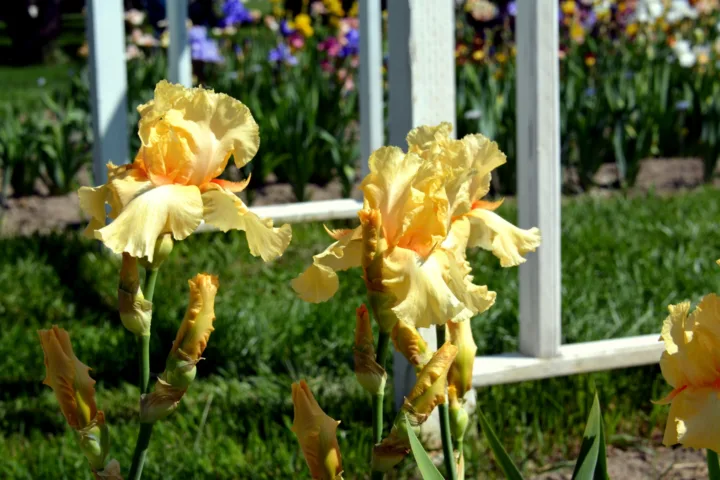
The most reliable iris planting ideas start with the site you already have, not the prettiest photo. Match the iris type to your sun and moisture, plant it at the depth that type needs, and set rhizomes in odd-numbered groups so the bed looks designed instead of dotted. Late summer into early fall is the window most bearded irises want, which makes September a useful time if the soil still works easily.
Get the depth wrong and you will grow handsome leaves with few flowers. Get the type wrong and a dry-soil beauty will rot beside a pond. The ideas below are the practical layouts that survive both problems.
Match the iris to the moisture you already have
Irises are not one plant. They are a family with very different drinking habits, and that is the decision that saves the most trouble.
Bearded irises want full sun and soil that drains after rain. Their thick rhizomes store water and need a summer bake on top of the soil. Shade the crown or bury it, and bloom drops off.
Siberian, Japanese, and Louisiana irises tolerate more moisture. Siberians handle ordinary borders that stay evenly damp. Japanese and Louisiana types belong near ponds, rain gardens, or heavy soil that never fully dries. Yellow flag iris (Iris pseudacorus) is a true waterside plant and can spread aggressively in some regions, so check local guidance before you use it.
Dutch irises and tiny Iris reticulata grow from bulbs. Treat them like other fall-planted spring bulbs: sharp drainage, sun, and a deeper hole than a bearded rhizome ever wants.
| Type | Sun and soil | Planting depth | Spacing | Best use |
|---|---|---|---|---|
| Bearded | 6+ hours sun, well drained | Rhizome at or just above the soil | 12–24 in. | Paths, sunny borders |
| Siberian | Sun to light shade, moist | 1–2 in. below soil | 18–24 in. | Mixed borders, pond edges |
| Japanese / Louisiana | Sun, wet to damp | About 1–2 in. below soil | 18–24 in. | Rain gardens, pond margins |
| Dutch (bulb) | Full sun, light soil | 3–5 in. deep | 4–6 in. | Cutting rows, mixed beds |
| Dwarf reticulata | Full sun, sharp drainage | About 3 in. deep | 3–4 in. | Pots, rock gardens |
If your yard stays soggy after rain, skip tall bearded iris or raise the bed. If the site is hot, dry, and open, skip Japanese iris. That single match does more for flowers than any fertilizer.
Plant at the depth each type needs
Planting too deep is the mistake that shows up every spring as a clump of swords and no bloom. The American Iris Society is blunt about it: roots go down, the rhizome stays near the surface.
Bearded iris rhizomes stay nearly on the surface
Plant from July through September in most climates, and at least four to six weeks before a hard freeze so roots can settle. Soak firm, bare-root rhizomes in water for a few hours if they look dry.
Dig a shallow hole about 4 inches deep and 10 inches wide. Mound a ridge of soil down the center. Set the rhizome on that ridge like a saddle, roots fanned down both sides, leaf fan pointing the way you want new growth to travel. Backfill so the top of the rhizome stays visible or only dusted with soil. In very hot, sandy sites, a thin cover of soil is fine. In heavy soil, leave the top fully exposed.
Water once to settle the soil, then keep the site on the dry side until new roots take. Do not bury the rhizome under bark mulch. Mulch next to the clump if you must, but keep the crown baked and dry.
Moisture-loving iris go just under the soil
Siberian, Japanese, and Louisiana rhizomes do not need that same sunburn. Set them 1 to 2 inches below the surface, then water them in. They can take a light mulch. Space clumps farther apart than you think, because they form dense, grassy mounds and resent crowding after a few years.
Plant these in spring or from late summer into fall. If you buy them in pots, you can set them whenever the ground is workable, as long as you keep the root ball moist.
Bulb irises go deeper, like other spring bulbs
Dutch, English, and Spanish irises go in during fall, pointed end up, 3 to 5 inches deep in light soil. Dwarf Iris reticulata and Iris histrioides sit about 3 inches deep and only a few inches apart. They are the ones that earn a place in a shallow pot by the door.
Space them in groups so the bed looks finished
A single iris in a mixed border looks like a leftover. Three or five of one color, planted as a small triangle, reads as a planned patch.
For tall bearded types, space groups 12 to 24 inches apart. Close planting gives a faster show and forces you to divide sooner, usually in two to three years instead of three to five. Point the fans outward so new rhizomes grow away from the center instead of colliding.
Repeat the same color every few feet along a path if you want the eye to travel. Mix heights only when the shortest plants sit in front and never throw shade over a bearded crown after lunch.
Divide overcrowded bearded clumps in mid to late summer after bloom fades. Keep firm, thumb-thick pieces with a healthy fan. Discard soft, hollow, or borer-pocked sections.
Iris planting ideas for paths, borders, and small yards
Use the sword leaves as structure, not just the two-week flower show.
Line a walk with intermediate or dwarf bearded iris on the sunny side, then let catmint or thyme sit in front where it will not flop over the rhizomes. The path stays open, the flowers sit at eye level, and you can deadhead without stepping on crowns.
Along a foundation, keep tall bearded iris 18 inches or more from the wall so air moves and rain can dry the foliage. A row of one color looks calmer than a rainbow scatter. Save the mixed colors for a dedicated iris bed where you can see each variety.
On a slope or raised bed, bearded iris earn their keep. Water runs off, rhizomes stay dry, and the fans hold the soil better than a thin groundcover. Plant across the slope in staggered groups rather than a single straight line so the display does not look like a fence.
For a small front yard, one triangle of three matching tall bearded irises plus a low companion is enough. Add a second triangle of a different height if you want a longer bloom window. Early dwarf iris, midseason tall bearded, then Siberian later in the season can stretch color for weeks without stuffing the bed.
Pair companions that will not shade the crowns
Companions fail when they lean over bearded rhizomes. The flower may look pretty in May. By July the crown is in shade and next year’s bloom is already weaker.
Good neighbors share sun and drainage, bloom before or after iris, and keep their foliage off the rhizome:
- Alliums for globe shapes that rise through the fans and then disappear.
- Peonies behind the iris, not on top of it, for late-spring overlap and summer leaf cover.
- Catmint, lavender, or thyme at the front, trimmed so they stay low.
- Daylilies a full step away, where they pick up after iris fade without smothering the crown.
- Ornamental grasses only at the back of moisture-loving Siberians, never draped over bearded rhizomes.
Leave a clear collar of soil around every bearded clump. That bare ring is not a design flaw. It is how the plant flowers.
Skip aggressive spreaders right against the rhizomes. Mint, running daffodil clumps, and thick wood-chip mulch all create the same problem: shade, damp, and fewer buds.
Pots, slopes, and pond edges
Containers favor the small bulb irises. Use a pot with real drainage holes, a gritty mix, and Iris reticulata or Iris histrioides set about 3 inches deep. Park the pot in full sun. After bloom, keep the foliage growing until it yellows, then store the pot dry or tuck the bulbs into a garden bed.
Tall bearded iris can live in a wide, shallow container if you refuse to overwater and you keep the rhizome exposed. It is fussier than a ground planting. I’d choose the simpler in-ground mound when the soil holds water, because a pot that stays wet is a rot farm.
Pond edges belong to Siberian, Japanese, Louisiana, or true flag iris, not bearded types. Plant in the damp margin, not in deep standing water unless the variety is sold as aquatic. Keep garden soil and fertilizer out of the pond itself so you are not feeding algae.
Frequently Asked Questions
When is the right time for iris planting ideas in most yards?
Plant bearded rhizomes in July, August, or September, early enough for roots to grow before a hard freeze. Plant Dutch and dwarf bulb irises in fall with other spring bulbs. Potted Siberian or Japanese plants can go in from spring through early fall if you water them well.
How deep should iris rhizomes sit?
Bearded rhizomes sit at the soil surface, tops visible. Siberian, Japanese, and Louisiana rhizomes sit 1 to 2 inches under the soil. Dutch iris bulbs sit 3 to 5 inches deep. If last year’s clump made leaves and no flowers, scrape soil off the bearded crowns before you assume the plant is a lost cause.
Can I use iris planting ideas in pots on a patio?
Yes, if you pick the right type. Dwarf bulb irises are the easy pot crop. Bearded iris need a wide container, sharp drainage, and an exposed rhizome. Water to settle them, then let the mix dry between drinks. A saucer of standing water will undo the planting.
Why do established irises stop blooming?
The usual trio is too little sun, rhizomes buried or mulched, and a crowded clump that has not been divided in three to five years. Move them to six hours of sun, lift and replant at the correct depth in late summer, and discard the old woody center.
How far apart should I plant irises?
Tall bearded: 12 to 24 inches. Dwarf bearded: closer, about 6 to 9 inches. Siberian and Japanese: 18 to 24 inches. Bulb irises: 3 to 6 inches. Tight spacing looks full sooner and means you divide sooner.
What should I plant with irises so the bed is not empty after bloom?
Put alliums and peonies on the same timetable, then daylilies, salvia, or phlox for summer. Keep the low plants in front and the bulky ones behind. The iris foliage still earns its keep if nothing is sitting on the crown.
Plant one grouping before the first hard freeze
Choose one sunny, well-drained strip or one damp edge. Buy three rhizomes of a single variety, not twelve mixed colors. Set them at the depth that type requires, fans facing out, and leave the bearded crowns uncovered.
That small triangle is the planting idea worth repeating. Once it flowers, you will know exactly where the next three should go.