
A garden border looks designed when the plants share the same light and soil, sit in height layers, and repeat in small groups. That is the practical formula behind garden border planting ideas that still have a shape after the first summer flush fades.
Start with the bed you actually have. A hot strip by a driveway, a skinny fence line, and a damp north wall need different plants, not a prettier version of the same shopping list. Put structure in first: a few evergreens, grasses, or shrubs that keep an outline in winter. Then add the flowers. The rest of this guide gives you plant combinations, spacing, and the quiet mistakes that leave a border looking sparse in July and empty in January.
Match Plants to Light, Soil, and How Wide the Bed Is
Buy plants for the conditions, not for the photo on the tag. Right plant, right place is still the fastest way to avoid a border that needs constant rescue.
South-facing beds get the most heat. West-facing beds bake in the afternoon. East-facing beds get morning sun and afternoon shade. North-facing beds and the base of a high fence stay cooler and dimmer. Walk the border at 9 a.m., noon, and 4 p.m. before you shop.
Soil decides who lives. Clay holds water and nutrients but can sit wet in winter. Sand drains fast and dries out. Chalk is often thin and alkaline. The RHS planning advice is blunt about this: identify the soil first, then choose plants that already like it.
Width matters as much as style. A border under 2 feet deep cannot hold a tall shrub plus a middle layer plus a spilling edge. It will look like a single row of plants leaning on a fence. A bed 3 to 6 feet deep can take three layers. Deeper than that, you can hide a wall, add a small shrub, and still keep a soft front.
Check your hardiness zone before you fall for a plant that only shrugs off winter two zones warmer than yours.
| Border you have | Typical depth | Planting approach | What usually fails |
|---|---|---|---|
| Skinny path or fence strip | Under 2 ft | Upright plants, climbers, bulbs, one low edger | Wide shrubs and floppy perennials |
| Everyday mixed border | 3–6 ft | Three height layers in groups of 3–5 | One of every plant from the nursery |
| Deep bed or island | 6 ft or more | Tall structure at the back or center | Tiny plants lost in the middle |
| Hot, dry, full sun | 2–4 ft | Herbs, grasses, sedum, catmint | Thirsty shade plants |
| North wall or tree shade | 3–5 ft | Foliage first, spring bulbs, winter scent | Lavender, roses, and prairie daisies |
Stack Heights So the Border Has a Front, Middle, and Back
Layering is what stops a border from reading as a flat hedge of similar leaves. Tall plants go at the back against a fence, or through the center of an island bed. Medium plants carry most of the flower color. Low plants finish the front so the soil does not show.
A useful height split looks like this:
- Back: 4 to 7 feet. Shrubs, tall grasses, hollyhocks, foxgloves, or a trained climber.
- Middle: 2 to 4 feet. Salvias, coneflowers, roses, hardy geraniums, hydrangeas in shade.
- Front: 6 to 18 inches. Thyme, heuchera, sedum, lady’s mantle, dwarf hostas, low grasses.
You can break the rule on purpose. A see-through plant such as fennel, gaura, or a slender grass can sit closer to the front because you look through it, not at a solid wall of foliage.
Texture does as much work as color. Pair fine grassy leaves with broad hosta or bergenia leaves. Put a spike (salvia, penstemon) next to a daisy shape (echinacea, rudbeckia) next to a dome (heuchera, box, compact hydrangea). A border of only daisy flowers looks busy and still somehow unfinished.
Garden Border Planting Ideas You Can Copy by Condition
Pretty plant lists fail when the plants want different water. Keep each combination inside one set of conditions.
Full-sun border that does not collapse after June
Use a limited palette and repeat it. One reliable sunny mix is Russian sage or perovskia at the back, salvia and echinacea in the middle, and catmint or sedum along the front. Add a clump of ornamental grass such as calamagrostis or a compact miscanthus for movement and winter stems.
For a more cottage look, swap the sage for a shrub rose and thread foxgloves or alliums through the gaps. Keep the front low with thyme, erigeron, or a tidy hardy geranium.
Herbs earn their space here. Lavender, culinary sage, and oregano give scent, pollinator flowers, and foliage that still looks like something when bloom is over. They also handle the dry edge next to paving better than thirsty annuals.
Shade border that is more than a row of hostas
Shade borders live on leaves. Hostas, ferns, heuchera, and hakonechloa (Japanese forest grass) give you shape for months. Add spring bulbs and early flowers so the bed is not a green wait from March to May.
A workable shady mix is sarcococca or a compact holly at the back for winter structure and scent, astilbe or Japanese anemone in the middle if the soil stays moist, and heuchera plus a low fern or tiarella at the front. Snowdrops, daffodils, or scilla can go in pockets between the perennials.
Dry shade at the base of a wall is harder. Skip plants that want damp woodland soil. Look at epimedium, bergenia, hardy geraniums that tolerate shade, and ferns such as Dryopteris that cope with less water once established.
Narrow strip along a fence, path, or driveway
A narrow border needs height without bulk. Train a climber or an espalier fruit tree on the fence so the back layer uses air, not soil width. Then plant upright perennials in a staggered line, not a stiff single file.
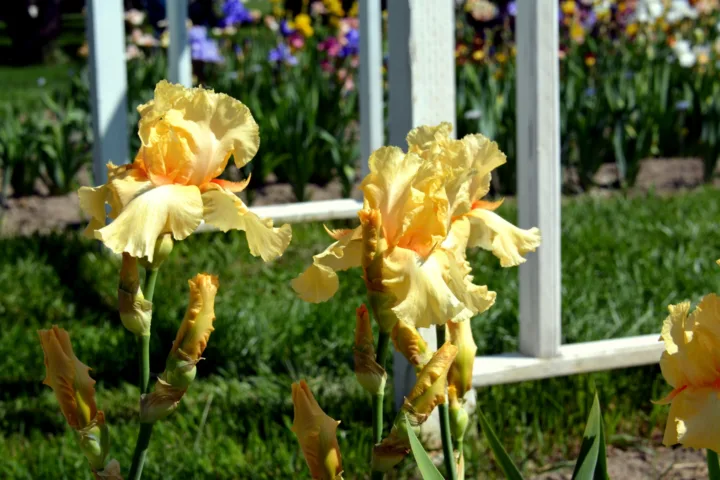
Good narrow-border plants stay slim: bearded iris, foxgloves, penstemon, alliums, red hot poker in sun, and ferns or foxgloves in shade. Soften the path edge with one repeating edger such as woolly thyme, mondo grass, or a compact heuchera.
Skip anything that wants a 3-foot-wide clump. That includes many hydrangeas, large hostas, and ornamental grasses sold in 1-gallon pots that become shrubs.
Space Plants by Mature Size, Not by How They Look in the Pot
The empty look in year one is normal. Crowding plants so the photo looks full on day one is how you get mildew, flopping stems, and a border you have to rip apart in year three.
The RHS planting guide uses a simple density check: about five herbaceous perennials, or three small shrubs, or one large shrub per square metre (roughly 11 square feet). That is a planning number, not a dare to pack more.
Set the pots on the soil before you dig. Start with the evergreen and structural plants. Then place repeated groups of the same perennial in odd numbers, usually three or five. Repeat those groups down the border so the eye has a rhythm to follow.
Plant in autumn or spring when the soil is workable and not frozen or waterlogged. Container plants can go in during summer, but they will ask for extra water until the roots catch up. After planting, a 2 to 4 inch mulch of compost or bark helps hold moisture and slow weeds.
Leave standing seedheads on grasses, echinacea, and sedum through winter if they still look decent. Cut the messy ones. The goal is a skeleton, not a tidy bald patch in November.
Mistakes That Make a Border Look Sparse or Chaotic
Most disappointing borders fail for ordinary reasons.
Planting one of each favorite is the classic. A single salvia disappears. Three or five of the same plant reads as a decision.
Ignoring mature width is next. A plant labeled 36 inches wide needs that space even when it looks lonely in May.
Building a June-only border is the third. If every plant peaks in early summer, July looks tired and January looks abandoned. Add at least one plant for spring bulbs, one for late summer or autumn, and one for winter stems, berries, or evergreen leaves.
Mixing wet-soil plants with dry-soil plants in the same short run of bed creates a watering problem you cannot solve. The hosta sulks or the lavender rots.
Letting pretty spreaders off the leash is the last one. Lady’s mantle, erigeron, and some hardy geraniums are charming until they seed into every gap. Japanese anemones and mint-family thugs can own a bed. Deadhead the seeders if you want control, and give the runners a hard edge or a pot.
Frequently Asked Questions
How many plants do I need for a garden border?
Measure length times depth to get the area. Use about five perennials, or three small shrubs, or one large shrub per square metre as a starting point. A 10-by-3-foot border is roughly 2.8 square metres, so you might plan 12 to 15 perennials plus one small shrub, not 40 tiny pots.
What should I plant at the front of a garden border?
Choose plants that stay under about 18 inches and still look decent after flowering. In sun, that is often thyme, catmint, sedum, erigeron, or a compact geranium. In shade, use heuchera, small hostas, tiarella, or a low fern. One repeating edger along the path does more than five different front plants.
When is the best time to plant a garden border?
Spring or autumn is the kind window. Roots settle while the air is mild and the soil still holds moisture. You can plan and prepare the ground in winter if it is not frozen. Summer planting is possible from pots, but you will water more.
What plants work in a very narrow garden border?
Think vertical. Use a climber or trained fruit tree on the fence, then add slim upright perennials and a single low edger. Iris, foxgloves, alliums, penstemon, and ferns earn their keep. Wide mounds and large grasses do not.
How do I stop the border looking empty in winter?
Keep a few evergreen shrubs, winter stems, or grasses that hold their shape. Sarcococca, hellebores, bergenia, holly, and many ornamental grasses do this job. If every plant is a soft perennial that dies to the ground, the border will vanish from December to March.
Plant the Bones First, Then Fill the Pretty Gaps
Choose the row in the table that matches your bed. Pick one combination that fits the light. Place the structural plants, set out the groups in odd numbers, and walk away from the extra impulse buy that wants different soil.
A border gets generous after it has a spine. Flowers are the easy part. The outline you can still see in February is the part worth saving to your board.